|
--------------------------------------------------
Two Toronto Fliers Get Hun Each
London, March 15, 1944 - (CP) - Spitfire pilots of a Canadian squadron escorting two-engined American bombers on an attack on Northern France today destroyed four German aircraft and damaged a fifth.
Four enemy fighters were shot out of the air and a bomber was attacked on the runway of an airfield near Cambrai.
The victors were F/Ls Alec Foch Halcrow, 26, of Penticton, B.C.; Henry Kemp Hamilton, 21, of 1 Clarendon Ave., Toronto; Jack Sheppard, 23, of Dollarton, B.C. and F/O David Douglas Ashley, 24, of 1097 St. Clarens Ave., Toronto.
Their victims were four Focke-Wulf 190's, shot down over an airfield where a Messerschmitt 410 was damaged on the runway by F/O Robert Kitchener Hayward, 27, of St. Charles, Nfld.
--------------------------------------------------
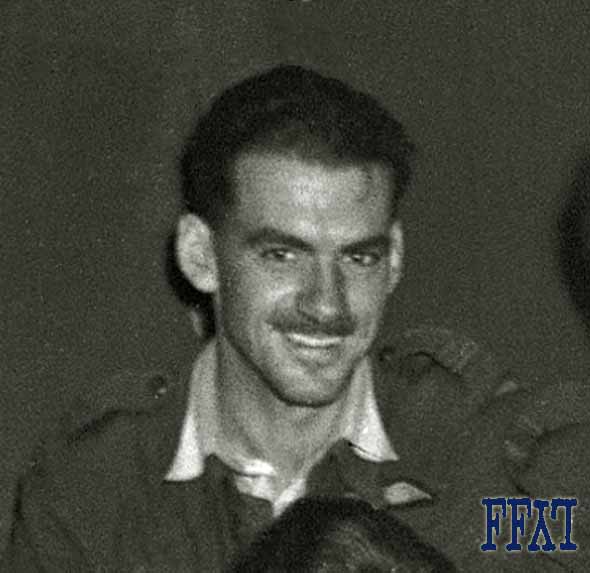
Also known as "Duke"
Born in Transcona, Manitoba, 4 November 1918
Educated in British Columbia
Home in Penticton, British Columbia
(mine surveyor and piper with Gordon Highlanders militia)
Enlisted in Vancouver, 18 December 1940
Posted to No.2 Manning Depot
To No.37 SFTS (guard), 26 January 1941
Trained at
No.2 ITS, 16 March 1941
(graduated and promoted LAC, 20 April 1941)
No.8 EFTS; graduated 8 June 1941
No.15 SFTS; Winged and commissioned, 20 August 1941
Posted to CFS, Trenton for instructors course
(13 September to 2 December 1941)
At No.31 EFTS, De Winton, 3 December 1941 to 12 Oct. 1942
(promoted Flying Officer, 20 August 1942)
At CTS, Rockcliffe, 13 October to 30 November 1942
At "Y" Depot, Halifax, 1-29 December 1942;
Arrived in Britain, 14 January 1943;
No.3 Personnel Reception Depot, Bournemouth, 15 Jan. 1943
No.17 (P) Advanced Flying Unit, 16 Feb. to 22 March 1943
No.52 OTU, 22 March to 1 June 1943
(although MI.9 report says No.57 OTU, Aston Down)
With No.401 Squadron, 1 June 1943 to 5 August 1944
(promoted Flight Lieutenant, 20 August 1943)
On 29 May 1944 he burst a tire on touchdown
He became airborne again, dropped his belly tank &
- made a good belly landing
With No.411 Squadron, 5 to 18 August 1944
(He was shot down by flak, baled out and was captured)
enemy permitted him to return to Allied lines
- to report their surrender on the 21st. See details below
Officially reported safe on 22 August 1944
To Repatriation Depot, 13 September 1944
To Canada, 23 November 1944
Returned to Britain, 5 December 1944
Back to Canada, 5 January 1945 &
Assigned to Western Air Command
Station Patricia Bay, 20 January to 18 May 1945
"Y" Depot, Moncton, 19 to 27 May 1945
Arrived in Britain by sea, 12 June 1945
Repatriated to Canada, 25 November 1945
Released 28 November 1945
Service career included 152 operational sorties
(225 operational hours)
Died in Vancouver, 15 April 1990 as per Airforce Magazine &
Legion Magazine of July/August 1990
Photo PL-19370 shows him in front of Spitfire |
Public Record Office WO 208/338 has MI.9 report of his being shot down and subsequent escape:
I took off from B.18 (T.8869 250,000, Sheet 3a and b) on 18 August 1944 at 1330 hours in a Spitfire Mark IXB to carry out an armed recce to the south of Vimoutiers (Q 4964 Sheet 7, 250,000). On the roads going south from Vimoutiers I attacked the convoy on the west road on a corner round (Q 4454). I came down from 3,000 feet to tree top height and gave them a four second burst of cannon and machine gun. I flew on for a bit "on the deck”, climbed to around 1,000 feet and made another low level attack in the same direction north-south.
It was on the second attack I was hit by some 20-mm shells - my propeller - both glycol and oil lines were hit - the engine about leaped out of its mountings. I called up my Squadron Leader, telling him I was returning to base. I found this to be quite impossible - the temperature was rising rapidly and there was a great danger of fire - so from 800 feet I baled out.
Just before I landed (U 3525) I noticed someone running to where I was going to land. My first impression was that he was a civilian. No sooner had I landed I released my harness and called out “Anglais”. That was fatal, the supposed civilian was German with a rifle. He covered me. Another German running out with a machine gun came and joined him.
They signaled me to walk towards a hedge where an officer and 20 men were standing. They started to take off my Mae West and help themselves to the chocolate, cigarettes and compass in the escape box; they handed the money back to me. While they were disrobing and robbing me one of them asked in English, “Have you been shooting up Red Cross wagons ?” I said No. They motioned me to sit down. They then went into a “huddle” and started to share out their booty.
The English speaking German asked me my rank. I said Captain; after a few minutes consultation with his officer he told me I would have to go to the Kommandant. Escorted by two Privates I was taken into his office. He asked me my rank and whether I was RAF. I nodded. Presumably he told my escort to take me to a place outside some 30 yards away.
Here I found five Americans, a Pole and a Russian. I asked them what type of fellows the guards were; they said they were mixed; they included Rumanians, Greeks, Italians, Poles and Russians. I reckoned that a little morale breaking was indicated. We got the Russian and the Pole working on them, and with my limited French I explained to them that the Luftwaffe was finished and that they were completely surrounded. Out came the “Safe Conduct” passes which had been dropped by the RAF - they each had one in their possession. One of the Italians came up to me and said, “Tomorrow, I your prisoner”.
Unfortunately the story must have got out because a pure (?) type German was added to our guards. Later during the evening around 2030 hours the Kommandant sent for my papers. I handed the messenger my 1250-R - it was returned shortly afterwards.
Along with seven cows, we slept the night in the stables. The next day (19 August) for breakfast we were given a piece of bread each. About 0900 hours the Kommandant came to tell us that there was no more food to be had, only a three-pound bag of granulated sugar which he left for us. Guards were changing hourly; they always put a pure (?) German in charge of the guards.
That afternoon - intermittent shelling went on for about two hours - nothing nearer than a quarter mile of us. We passed the night in the stable.
About 0200 hours we were woken up - we were on the move. The Germans wore their camouflage smocks. As I approached the stable door both my arms were grabbed and in this manner I was marched to a truck hidden under some trees. Four of us (a Russian, two Americans and myself) were put in one truck, and a Pole and three Americans in the other. There were 20 guards to each truck.
For about two hours we drove through congested roads and without lights. We passed a lot of horse-drawn artillery on the way. The convoy eventually stopped about four kilometers short of Tournay sur Dives (U 3226). The reason for this was that the convoy was being shelled around Tournay sur Dives. We were taken across fields, with about six or seven thousand infantry men to join up with the convoy south of the town.
British shelling was amazingly accurate, piles of destroyed vehicles - dead horses and Germans littered the area - approximately at U 3124 British ranks appeared (53 Division, I believe) from out of the woods. Throwing their arms away the Germans went “hell for leather” towards Tournay sur Dives. I followed suit, close by was one of the guards.
In the mad melee only one American and myself kept together. Around U 3125 about 40 Germans and ourselves took shelter in a basemen of a house. We were joined shortly by about twelve Boschs.
Next morning around 0700 hours (20 August) we went into the adjoining house which had been set up as a First Aid Post. The American, Private Palango and myself were welcomed by the two German doctors and four orderlies with open arms. They gave us food, drink, tobacco and cigarette papers to roll our own cigarettes. One of the orderlies who spoke a bit of English impressed upon me that when we were rescued to explain to the troops how well we had been treated and not to leave them behind.
During the after around 1800 hours, Thunderbolts dive-bombed the place. The Germans were really shaken by these attacks.
About 0700 hours [21 August] an SS type hobbled in; he had been hit by a shell in the foot - Ludovie was his name, 18 years old, had already been in the army a year. Despite his wound he was tough and arrogant. Openly they discussed surrendering. Little by little the SS boy gave way. I told him he would be well looked after in a hospital; if he insisted on staying, gangrene would set in and he would lose the leg. Finally he was won over.
I and one other German, a stretcher bearer, began to walk down the road to find our lines - we ran into the Cure. He showed us where the lines were. We walked down the road carrying a large Red Cross flag between us. I carried a note from one of the Germans. It stated that many Germans in the village wanted to surrender. I met Major Petersen of the Glengarry Highlanders (Canadian) and gave him the note. He said he could not spare any men to go and fetch them. Already he had 700 surrendered to him including two Generals. From here I went to Battalion Headquarters and through to Creully.
Transcriber’s Note: “Major Petersen” is most likely Major John Frederick Peterson (Stormont, Dundas and Glengarry Highlanders), awarded the DSO 17 March 1945.
--------------------------------------------------
Ships Everywhere -
Smoke Over Invasion Area Just Like Autumn Leaf Fires to Spitfire Pilot
A 25-gear-old Spitfire pilot from Penticton, who got a "probable" over the Allied beachhead in France, describes what a pilot sees when he looks down on the English Channel and French coast on the second day of the invasion.
By F/L A. HALCROW, an R.C.A.F. Airfield in Britain, June 7, 1944 (CP) — What does a battlefield look like? That's hard to say.
It looks quiet until you take a good look at things. About the only thing that lives up to Hollywood's idea of war is the smoke rising from the flaming centre of Caen.
But if you take only a casual glance from the air it looks just like autumn back home when people are burning leaves, Here's a picture as I saw it today.
Thousands of Ships
Half-way across the Channel you come across the lane of shipping. There are transports, tank landing craft, destroyers, escort ships, corvettes going in either direction all the time. Then when you get over the beachhead there are thousands of ships from the big battlewagons down to smaller stuff.
There's a lot of shelling. The beach area is littered with barges. Looking at the boats from the air, it is just as if you picked up handfuls of ships and scattered them all over the place — they're just everywhere.
Sprayed With Craters
The magnitude of it all is almost too great to comprehend. You've got to be in the air to appreciate it.
Bomb craters? There are all kinds of them in concentrated areas along the eastern end of the beachhead. A couple of areas about 500 by 800 yards are literally sprayed with craters.
The fields are green and the cows are grazing contentedly, while our troops move inland in single file along roads, walking beside Bren gun carriers and other transport.
Tanks and Horses
In inland fields there are no bomb craters. But I saw what must have been mortar bombs looping from one side of the field to the other.
I was struck particularly by the bunch of horses — about 20 — grazing in one field, with a long line of tanks thundering beside them.
Coastal batteries really have been knocked about, but the average small hamlet inland looks intact. Jerry must have retreated pretty fast if he had anything in there at all.
The roads appear to be little damaged, as transport is just rolling down them to beat hell. In the air you just can't move for aircraft — ours!
Glider Concentrations
I saw two concentrations of gliders on the ground.
There were parachutes of various colors scattered all over the place in one area.
After I watched the horses grazing, I was chasing along after my JU88 — which turned out to be a probable destroyed — when at a height of about 800 feet I saw an old couple waving frantically at us.
Still, with all that, it doesn't look like Hollywood's way of conducting a war.
--------------------------------------------------
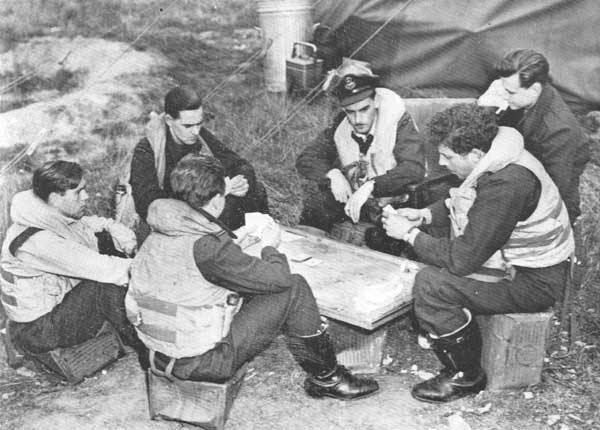
October 1943, 401 Sq. dispersal. Clockwise from -
Bill Tew (back to camera), Bob Lawson, F. B. Evans, Halcrow, D. M. Wilson & Bill Klersy
--------------------------------------------------
RCAF Shoots Down 26 Enemy Planes
in Normandy Between Dawn and Dusk
By P/O H. R. McDONALD, A Canadian Airfield in France, June 29, 1944 - (CP) - Canadian fighter planes, in one of the most brilliant achievements in the history of the R.C.A.F., shot down 26 out of a total of 34 enemy aircraft destroyed over the Normandy front between dawn and dusk yesterday.
In addition, R.C.A.F. pilots chalked up a number of enemy planes probab1y shot down and a number bf others which were damaged.
Four pilots scored double kills. They were Wing Cmdr. J. E. (Johnny) Johnson, English–born commander of a Canadian fighter wing operating from an R.C.A.F. base in Normandy, and F/Ls. H. C. Trainor, Charlottetown; W. T. Klersy, 14 Harcroft Rd., Toronto, and R. K. Hayward, St. John's, Nfld.
Destroys Two, Damages Third
Hayward destroyed two FW-190's and damaged a third, which gave him the highest R.C.A.F. individual score of the day.
Earlier reports indicated the Canadian airmen had downed 18 enemy planes in yesterday's daylight operations.
The complete figures were reached by intelligence officers today after a period of aerial operations which exceeded in intensity anything since the Allied Normandy beachhead was opened June 6.
Besides the toll of enemy planes, which included all fighter types, R.C.A.F. pilots also strafed transport on the roads.
Final claims on two aircraft are being sifted
Among the R.C.A.F. Spitfire pilots contributing to the total with one Hun each were: F/Ls. Irving Kennedy, Cumberland, Ont.; G. R. Patterson, Kelowna, B.C.; J. McElroy, Kamloops, B.C.; Henry Zary, New York; R. M. Stayner, Saskatoon; A. F. Halcrow, Penticton, B.C.; G. W. Johnson, 102 Beechwood Ave., Hamilton, Ont.; D. E. Noonan, 146 Willingdon Ave., Kingston, Ont.; J. B. Rainville, Montreal; and Flying Officers W. J. Banks, Leaside, Ont. and G. H. Farquharson, Corbyville, Ont.
Wing Cmdr. Johnson's score of two brought his total of enemy planes downed to 32, equaling the mark set by Group Capt. A. G. (Sailor) Malan, a South African, now on ground duty.
Among the R.C.A.F. fliers scoring probables were F/O A. C. Brandon, Timmins, Ont.; F/O J. B. O'Sullivan, Vancouver and P/O J. M. Flood, Hearst, Ont.
Nine Others Damaged
At least nine others wire damaged by fliers of the R.C.A.F.
Of the wings comprising Group Capt, W. (Bill) MacBrien's R.C.A.F. sector, the one led by 22-year-old Wing Cmdr, George Keefer, D.F.C. and Bar, Charlottetown, was high scorer of the day with 13 confirmed victories. Johnson's wing was second with seven, in a close race with a unit led by Wing Cmdr. R. A. Buckham, Vancouver.
The margin for Keefer's wing was established in two dusk operations in which seven enemy planes were destroyed and two damaged. In the first action Hayward sighted more than 25 Nazi fighters and led his formation in pursuit. He damaged one.
Later the same Spitfires became embroiled with a dozen FW-190's, and Hayward got two of them. The first fell out of control, and the second burst into flames and crashed after Hayward had followed it down to tree-top height.
"The Huns were like bees,” said WO. Murray Havers, 1 Lloyd St., Hamilton. Ont. "They seemed confused and acted as though they did not know what they were doing."
The Canadian airmen said the Germans did not put up much of a fight despite their numerical advantage.
Other Canadians credited with kills during the day were F/O G. R. Stephen, Montreal; F/O Larry Robillard, Ottawa; F/O W. A. Gilbert, Dartmouth, N.S.; F/O Don Goodwin, Maynooth, Ont. and F/O Tommy Wheler, 10 Beauford Rd., Toronto.
F/O Klersy took a prominent part in athletics at St. Michael's College, playing hockey and rugby. He also rowed for his college, and was goalie for Ostrander's mercantile hockey team. Enlisting in June 1941, he took aircrew training in Toronto, Oshawa and Dunnville and after nearly a year with a fighter squadron at Bagotville, F/O Klersy went overseas in May 1942.
The 21-year-year old airman is the son of Mr. and Mrs. W. P. Klersy, 14 Harcroft Rd.
--------------------------------------------------
HALCROW, F/L Alexander Foch (J6795) - Distinguished Flying Cross - No.411 Sq.
Award effective 8 December 1944 as per London Gazette of that date and
AFRO 293/45 dated 16 February 1945.
Flight Lieutenant Halcrow is a keen and resolute fighter. He has led his flight and, on occasions the squadron, in many successful attacks on a variety of targets. He has displayed praiseworthy skill and determination throughout. In air fighting, Flight Lieutenant Halcrow has destroyed four enemy aircraft.
--------------------------------------------------
Victories Include :
15 March 1944
7 June 1944
28 June 1944
20 July 1944
27 July 1944 |
one FW190
one Ju88
one FW190
one FW190
one Me109 |
destroyed
probable
destroyed
destroyed
destroyed |
Cambrai
south of Caen
Conde sur Noireau
southeast of Caen |
4 / 1 / 0
He also destroyed about 100 enemy vehicles and three locomotives
--------------------------------------------------
|